U-02 · pruebas · July 2026
Attention Is All You Need: the seed of modern generative AI
The problem: reading in single file
Before 2017, almost all language processing relied on RNNs and their more robust variant, LSTMs. They work sequentially: they read the sentence word by word, updating a single “state” at each step that gets carried all the way to the end.
"the" → "cat" → "sleeps" → ... → final stateIf you know distributed systems, this should sound familiar: it’s a single-threaded pipeline. Each step can only start once the previous one finishes, and all the information in the sentence has to survive compressed inside that single, constantly rewritten state. The longer the sentence, the more whatever was at the beginning gets diluted — the linguistic equivalent of the vanishing gradient: the signal fades out as it passes through more steps.
Two direct consequences:
- It can’t be parallelized. Step 10 depends on step 9, which depends on step 8… There’s no way to split the computation across several GPUs at once for the same sentence, so training is slow.
- Long-range dependencies get lost. If the subject of a sentence is 30 words away from the verb that needs it, that relationship has to survive 30 steps of state-rewriting, compressed the whole way. In practice, it degrades.
The paper by Vaswani et al. (Google Brain, 2017) starts from an uncomfortable question: what if we get rid of sequentiality entirely?
The twist: everyone talks to everyone at once
The paper’s answer is the Transformer architecture, and its central piece is the attention mechanism (hence the title: attention is all you need).
Instead of a pipeline where each token waits its turn, every token queries directly and in parallel every other token in the sentence to decide how much it should care about each one. It’s the same leap that separates a system where nodes communicate in a chain from one where any node can query any other node directly, all at once:
RNN (sequential):        the → cat → sleeps

Transformer (attention):    the
                            ╱ │ ╲
                        cat ─┼─ sleeps
                            ╲ │ ╱
                    (every token queries every other token in parallel)
Nothing gets lost along the way because nothing has to travel along the way: any token can look directly at any other, whether it’s one word away or a hundred.
Why it’s needed: the ambiguity attention resolves
Before getting into the mechanics, it’s worth seeing what concrete problem attention solves. Take this word:
“We saw the bank from the riverside.” “The bank approved my loan.”
Same word, completely different meaning. A human resolves it without thinking: they look at the rest of the sentence — “riverside” in one case, “loan” in the other — and use that to decide what “bank” means in that context.
That’s literally what attention does: each word builds its meaning by consulting, with different weights, the other words in the sentence. “Bank” doesn’t have a fixed meaning stored in a lookup table; its representation gets recomputed every time based on its context.
The math, with real weight but still digestible
This is where most explanations stop at the metaphor. Let’s go one step further, with a small example you can follow by hand.
Each token isn’t compared directly against the others: first it’s projected into three separate vectors, called Query, Key, and Value (Q, K, V). The most intuitive way to see it is as a search:
- Query: what this token is “asking” — what kind of information it needs.
- Key: the “label” each token offers itself up to be found by.
- Value: the actual content that token contributes if it’s chosen.
It’s literally a search mechanism: your Query gets compared against every available Key, and you walk away with a blend of the Values, weighted by how well each Key matched your Query.
In a real Transformer, Q, K, and V come from multiplying each word’s embedding by three weight matrices (W_Q, W_K, W_V) learned during training. To keep the calculation doable by hand, this example simplifies things and uses the embedding directly as Q, K, and V all at once — the mechanics that matter (dot product, scaling, softmax, weighted sum) are exactly the same.
Take the sentence “the cat sleeps”, with toy 2-dimensional embeddings:
x_the    = [1, 0]
x_cat    = [0, 1]
x_sleeps = [1, 1]
To compute the new representation of “cat” after attention:
1. Dot product of its Query against every Key (how similar they are):
score(cat, the)    = [0,1]·[1,0] = 0
score(cat, cat)    = [0,1]·[0,1] = 1
score(cat, sleeps) = [0,1]·[1,1] = 1
2. Scaling by √d_k (d_k = dimension of the vectors; here, in the toy example, 2, so √2 ≈ 1.41 — in the real Transformer, with 8 heads splitting 512 dimensions, d_k = 64). Without this scaling, in large vectors the dot products grow large, the softmax saturates — nearly all the weight lands on a single word — and its gradients shrink to almost nothing: the same vanishing gradient we already saw with RNNs, now ambushing us from inside the very mechanism that was supposed to fix it:
0 / 1.41 = 0.00
1 / 1.41 = 0.71
1 / 1.41 = 0.71
3. Softmax — turns those scores into weights that sum to 1 (how much “attention” “cat” pays to each word):
weights ≈ [0.20, 0.40, 0.40] # the, cat, sleeps4. Weighted sum of the Values using those weights:
output_cat = 0.20·[1,0] + 0.40·[0,1] + 0.40·[1,1]
           = [0.60, 0.80]
The result, [0.60, 0.80], is the new representation of “cat” — it’s no
longer just “cat” in the abstract, it’s “cat” after looking at its
context: 40% comes from itself, 40% from “sleeps” (the verb it’s the
subject of), and only 20% from the article “the”, which contributes
little information. The model doesn’t know grammar — but the resulting
weight pattern ends up looking a lot like what a linguist would underline
by hand.
Try it yourself: attention live
The example above was computed by hand for “cat”. Here you can recompute it for all three words and watch the weights change — same toy embeddings, same calculation, live:
—
Multi-head attention: several observers at once
A single attention pass captures one type of relationship. But language has several layers of relationship happening simultaneously: syntactic (“sleeps” agrees with “cat”), referential (what “it” refers to), thematic (what the sentence is about)…
The paper’s solution is to run several attention heads in parallel (the original Transformer uses eight), each with its own independently learned W_Q/W_K/W_V matrices. It’s, again, the same distributed logic: instead of a single observer trying to capture everything at once, several specialized observers look at the same sentence from different angles, in parallel, and their results get combined at the end.
Encoder and decoder: two halves with different jobs
So far we’ve talked about “attention” in the abstract, but the original paper isn’t solving an abstract problem: it’s solving machine translation (“the cat sleeps” → “el gato duerme”). For that, the Transformer is organized into two halves with different jobs, each stacked 6 times:
- The encoder reads the full input sentence (in English) and produces an enriched representation of each word, with the context of the whole sentence already baked in. It’s the attention block we’ve seen so far: every token consults every other token, without restriction, because the whole sentence is already available at once.
- The decoder generates the output sentence (in Spanish) word by word, and at each step makes two separate queries: first to what it has already generated itself, and then to the encoder, to decide which part of the original sentence to focus on in order to produce the next word.
Each block — encoder or decoder — isn’t just attention: it’s attention followed by a feed-forward network (two linear layers with a ReLU in between — 512 → 2048 → 512 in the original Transformer — applied to each position separately, with the same weights for all of them), and each of the two pieces is wrapped in a residual connection + normalization (“Add & Norm”): the layer’s output gets added to its own input before being normalized. It’s the same trick that prevents the vanishing gradient in very deep networks — here with 6 stacked layers on each side — each layer only has to learn a correction on top of what it already had, not rebuild the whole signal from scratch.
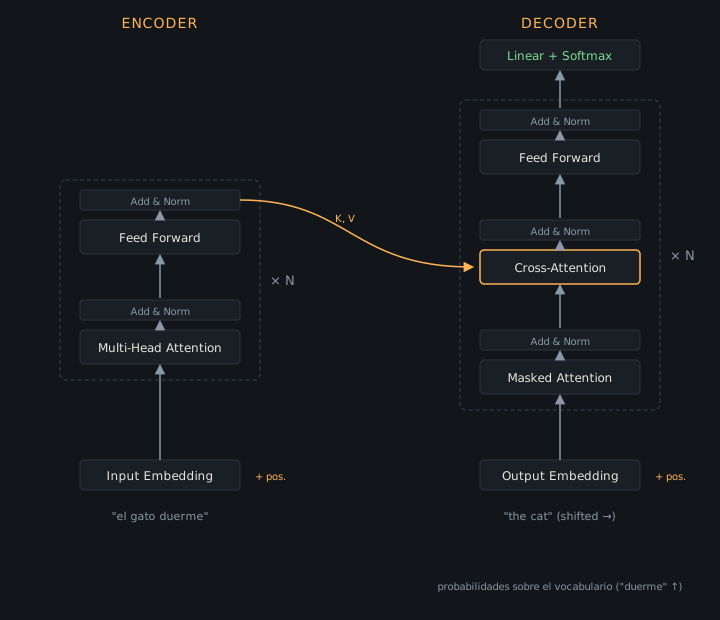
Two details that tend to cause confusion:
- The decoder’s attention is “masked”. When generating word number 5,
the decoder can’t consult words 6, 7, 8… because at generation time
they don’t exist yet — it’s autoregressive, just like the RNN we were
replacing. It’s the same principle as a commit log: you can read
everything that’s already committed, never what hasn’t been written
yet. That’s why it’s called masked self-attention: the score of a
token against any future token is forced to
-∞before the softmax, so its weight ends up being exactly 0. - Cross-attention is where the actual translation happens. There, the Query comes from the decoder (“what do I need to generate the next word in Spanish?”), but the Key and Value come from the encoder (“this is what the English sentence says”). It’s the same Q/K/V mechanics as before, except the three no longer come from the same sentence.
Watching it move
The diagrams above are static. This one isn’t: hit “Step” and follow the data climbing block by block through the encoder, and then how the decoder generates the translation word by word, reusing the same K, V the encoder computed just once.
"the cat sleeps"
<start>
This clears up something the article glossed over earlier: not every current model uses both halves. BERT is encoder-only (bidirectional, built to understand text, not generate it). GPT and Claude are decoder-only — with their masked attention — used on their own, with no cross-attention because there’s no separate “source sentence”: the model only ever consults itself, predicting the next token from everything it has already written. The original paper, with both full halves, was still built for translation; the leap to “a single decoder that generates anything” came later, with GPT.
Positional encoding: recovering order without sequence
Here’s a problem the design itself creates: if every token consults every other token at once, how does the model know that “dog bites man” is different from “man bites dog”? Attention, as described so far, is blind to order.
It’s exactly the same problem vector clocks solve in distributed systems: when there’s no global clock and no guaranteed arrival order, you need to explicitly inject a marker that encodes each event’s relative position. The Transformer does the same thing with positional encoding: a vector encoding its position in the sentence (using sine/cosine functions of different frequencies) gets added to each embedding before any attention calculation begins. It’s not that the model “remembers” the order while processing — the way an RNN would — it’s that the order gets baked into the data itself, once, at the very start.
The paper also tried the more obvious alternative — treating position as just another embedding, learned during training — and got nearly identical results. They stuck with sine/cosine as a bet on the future: in theory, it lets the model extrapolate to sentences longer than any it saw during training.
Why this unblocked everything
| RNN / LSTM | Transformer | |
|---|---|---|
| Processing | Sequential, step by step | Parallel, all tokens at once |
| Long-range dependencies | Degrade with distance | Direct connection, regardless of distance |
| Training | Slow, hard to parallelize | Fast on GPU/TPU, highly parallelizable |
| Scalability | Limited | Models with billions of parameters |
Parallelization isn’t a minor engineering detail: it’s what made it possible to train on orders of magnitude more data and more parameters in a reasonable amount of time. Without it, there would be no GPT, no BERT, no Claude as we know them.
The paper’s own numbers confirm it: its large model reached 28.4 BLEU on English-German translation and 41.8 on English-French — beating the previous state of the art — trained in 3.5 days on 8 GPUs. For a task that used to be measured in weeks of training, that speed jump was as newsworthy as the improvement in translation quality.
In 2017 this looked like just another academic paper, with good results on machine translation. In 2026 that same architecture is in your phone, in your browser, in the tools you use every day. It’s not that there was no AI before — there was, and it looked quite different: specialized models for each task. What changes with this paper is that, for the first time, a single general architecture — the Transformer, built entirely on attention — becomes the reusable foundation for almost everything we now call generative AI.
Reference
Vaswani, A., Shazeer, N., Parmar, N., Uszkoreit, J., Jones, L., Gomez, A. N., Kaiser, Ł., & Polosukhin, I. (2017). Attention Is All You Need. arXiv:1706.03762.
Field notes
(This is where I document my own doubts and findings while writing this: which parts of the distributed-systems analogy hold up best under scrutiny, what questions you all asked me after reading it, what I’d save for a second piece on the full Transformer architecture…)